
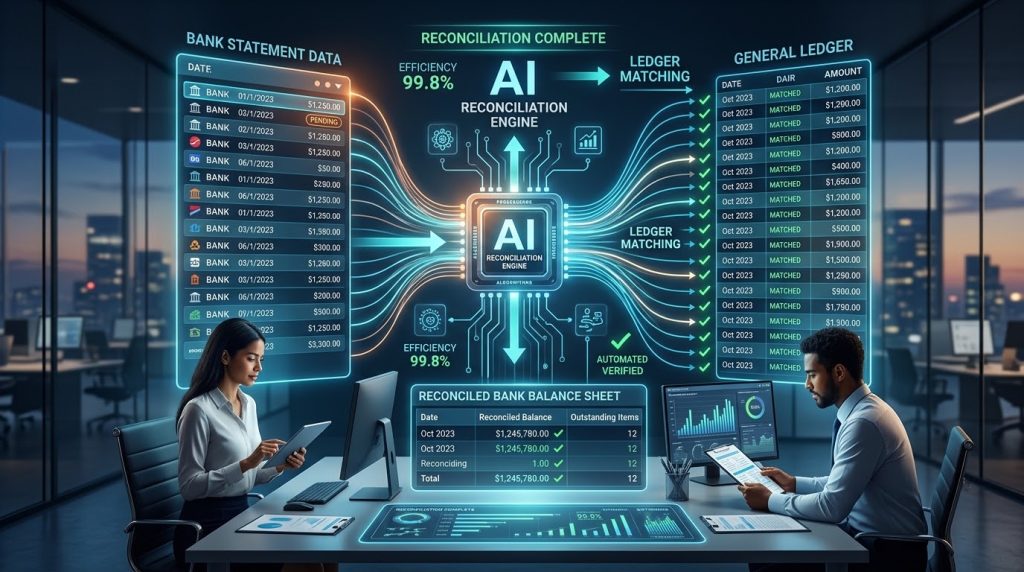
For decades, the bank reconciliation process has stood as both a cornerstone of financial integrity and a notorious bottleneck in corporate accounting. From cross-referencing messy spreadsheets and manually tracking timing differences to parsing cryptic transaction descriptions, accountants have spent countless hours simply proving that internal ledgers match external statements.
Today, the integration of Artificial Intelligence (AI) and Machine Learning (ML) is shifting reconciliation from a slow, backward-looking chore into an intelligent, near real-time operational engine.
The Traditional Bottlenecks of Bank Reconciliation
At its core, bank reconciliation ensures that a company’s cash records accurately reflect its bank accounts. However, conventional manual processes face persistent challenges:
- Volume and Fragmented Data: Global transactions, varied payment gateways (Stripe, PayPal, wire transfers), and multi-currency accounts generate massive streams of disparate data.
- Cryptic Reference Data: Bank feeds rarely present clean, uniform information. Incomplete merchant names, truncated invoice numbers, and differing date stamps frequently derail basic rule-based matching.
- Many-to-One and Split Transactions: When a single payment clears several invoices, or when merchant batch settlements combine dozens of sales minus transaction fees, simple deterministic software falls short.
- Human Error and Delayed Closes: Manual reviews create audit fatigue, increase the likelihood of overlooked discrepancies, and delay the monthly or quarterly financial close.
How AI Upgrades the Reconciliation Engine
AI does not merely run faster “if-this-then-that” scripts; it brings cognitive capabilities—contextual understanding, pattern recognition, and continuous learning—to transaction workflows.
1. Intelligent Character Recognition (ICR) and NLP
Natural Language Processing (NLP) parses noisy, unstandardized transaction descriptions. An AI system can recognize that "VNDR*SUPPLY-CORP #9842 NY" refers to "Supply Corporation" and matches purchase order PO-09842, even if reference formats diverge.
2. Fuzzy Matching and Probabilistic Scoring
Traditional software demands exact matches on dates, amounts, and reference codes. AI uses probabilistic matching algorithms that evaluate confidence scores across multiple variables simultaneously:
- Adjusting for weekend/holiday clearing delays.
- Grouping multiple line items into a single lump-sum deposit.
- Recognizing recurring bank fees, foreign exchange differences, or processing charges automatically.
3. Continuous Learning (Human-in-the-Loop)
When an accountant resolves an unmatched transaction, modern AI platforms observe the resolution. Over time, the model internalizes company-specific naming conventions and edge-case exceptions, reducing future manual interventions without requiring IT to hardcode new rules.
4. Anomaly Detection and Fraud Prevention
Unlike static threshold alerts, unsupervised ML algorithms establish baselines of normal financial behavior. If a payment frequency changes unexpectedly, an unauthorized wire transfer occurs, or a duplicate payment slips through under an altered invoice number, the system flags it immediately for investigation.
Traditional vs. AI-Powered Reconciliation
| Dimension | Traditional / Rule-Based Matching | AI-Driven Reconciliation |
| Matching Rates | 60% – 75% on clean feeds | 90% – 98%+ across varied formats |
| Complex Transactions | Requires manual review for splits and batches | Automated many-to-one and bundled fee recognition |
| Handling Novel Variations | Fails when format or vendor name shifts | Understands context via NLP and semantic analysis |
| Frequency | Monthly or weekly batch processing | Real-time, continuous reconciliation |
| Exception Handling | Manually re-investigated every cycle | Model learns from human resolution for next time |
Key Benefits for Finance and Accounting Teams
- Faster Month-End Close: By reconciling continuously rather than waiting until period-end, finance teams shave days off the close cycle.
- Higher Data Accuracy & Audit Readiness: Automated audit trails log exactly why a match was proposed, the confidence score assigned, and who approved any exceptions.
- Working Capital Visibility: Treasury and C-suite leaders gain an accurate, real-time snapshot of available cash across all accounts, supporting better forecasting and investment decisions.
- Strategic Shift for Talent: Rather than spending hours on mechanical data entry, finance professionals can focus on variance analysis, working capital optimization, and financial strategy.
The Road Ahead: Continuous Accounting
The future of financial operations is moving toward continuous accounting—an environment where transactions reconcile as they happen, exceptions surface instantly, and the period-end close becomes a non-event.
Embracing AI in bank reconciliation is no longer just an efficiency upgrade; it is the foundation for an agile, resilient, and forward-looking finance function.